

Generate game-ready low poly 3D models from any image or text prompt. Set your exact face count target from 500 to 150,000 and let Neural4D handle the rest. No manual retopology. No mesh cleanup.
What is Low Poly Modeling? It is the technical practice of designing 3D assets with a minimal number of polygonal faces (typically 5,000 to 30,000 triangles) to drastically reduce rendering overhead in real-time applications. Neural4D transforms this tedious manual process into a unified pipeline. Our AI Retopo engine analyzes the curvature of your high-density generation and intelligently collapses edges, delivering optimized Low Poly assets without destroying essential geometric silhouettes.
Take full control of your asset budgets. Generate highly detailed organic or hard-surface models initially (up to 1,000,000 faces), then utilize our Retopo interface to compress the topology down to your exact specified target ranging from 500 to 150,000 faces.

Reducing geometry doesn't mean sacrificing visual fidelity. The Direct3D-S2 engine intelligently retains native 4K PBR maps (Albedo, Normal, Roughness, Metalness), using high-resolution textures to simulate complex surface details on ultra-low poly counts.

Skip the manual cleanup phases entirely. Our low poly generation outputs 100% mathematically watertight manifold meshes, eliminating non-manifold edges and flipped normals to ensure immediate compatibility with Unity, Unreal Engine 5, and Godot.
Optimized low polygon count meshes unlock extreme rendering efficiency across demanding real-time platforms.

Dramatically reduce draw calls and memory footprints for mobile and hyper-casual games. Generate thousands of unique environmental props tightly capped at 5,000 faces per asset to maintain stable 60FPS framerates.

Deliver frictionless browsing experiences. Low poly decimated models guarantee millisecond loading times on low-end cellular networks, ensuring your WebGL or <model-viewer> product catalogs convert instantly.

Populate expansive metaverse environments without overwhelming rendering hardware. Low poly AI generation allows level designers to fill horizons with lightweight background buildings, vehicles, and flora.

Embrace the highly popular geometric Low-poly art style for additive manufacturing. Export watertight, boldly faceted meshes that slice perfectly and create stunning physical desk toys and geometric sculptures.
Start by leveraging Neural4D's Text or Image to 3D capabilities. Describe your intent or upload a photo to generate an initial, ultra-high resolution mesh (typically 100,000 to 1,000,000 faces) containing rich geometric details.
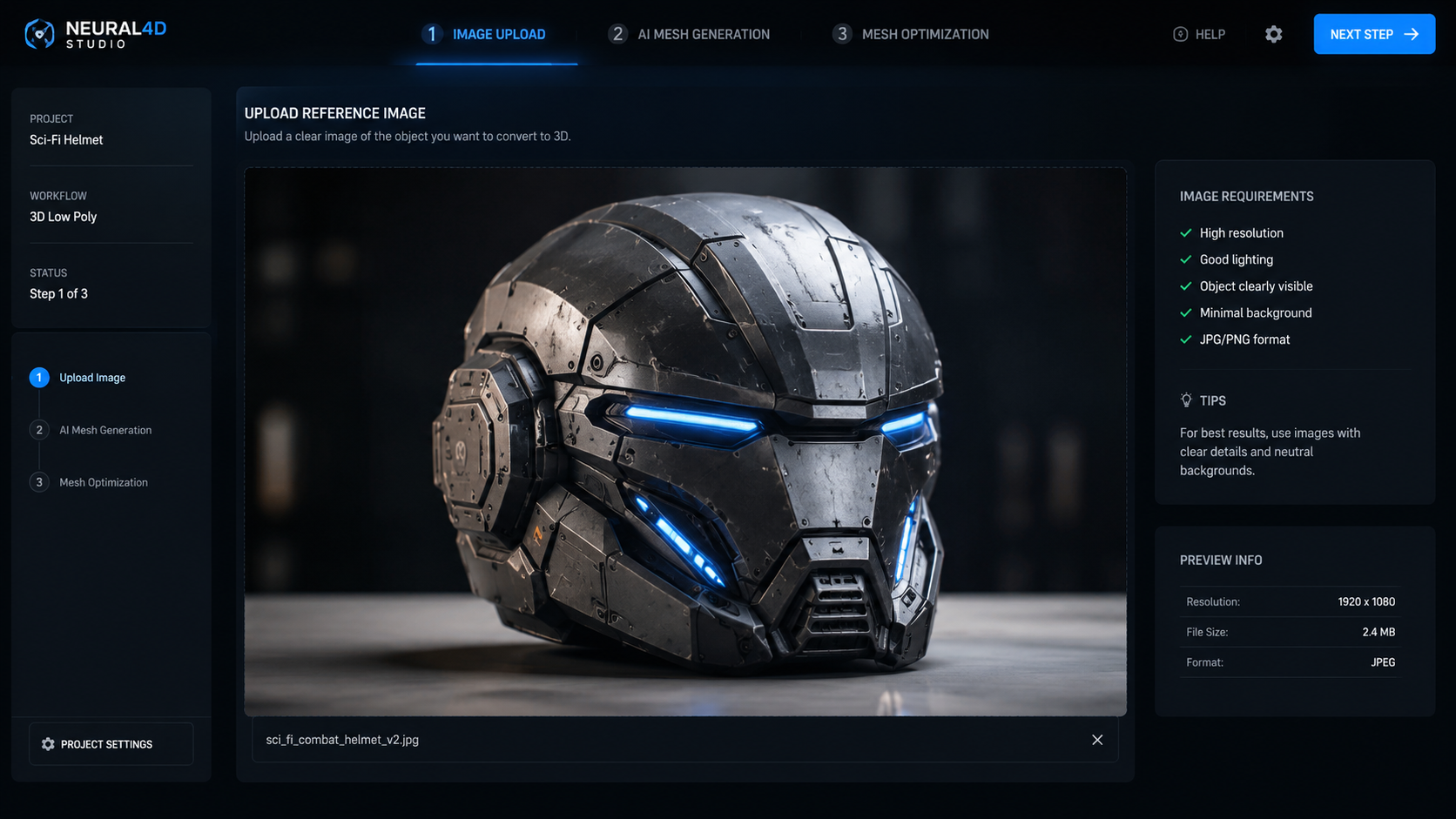
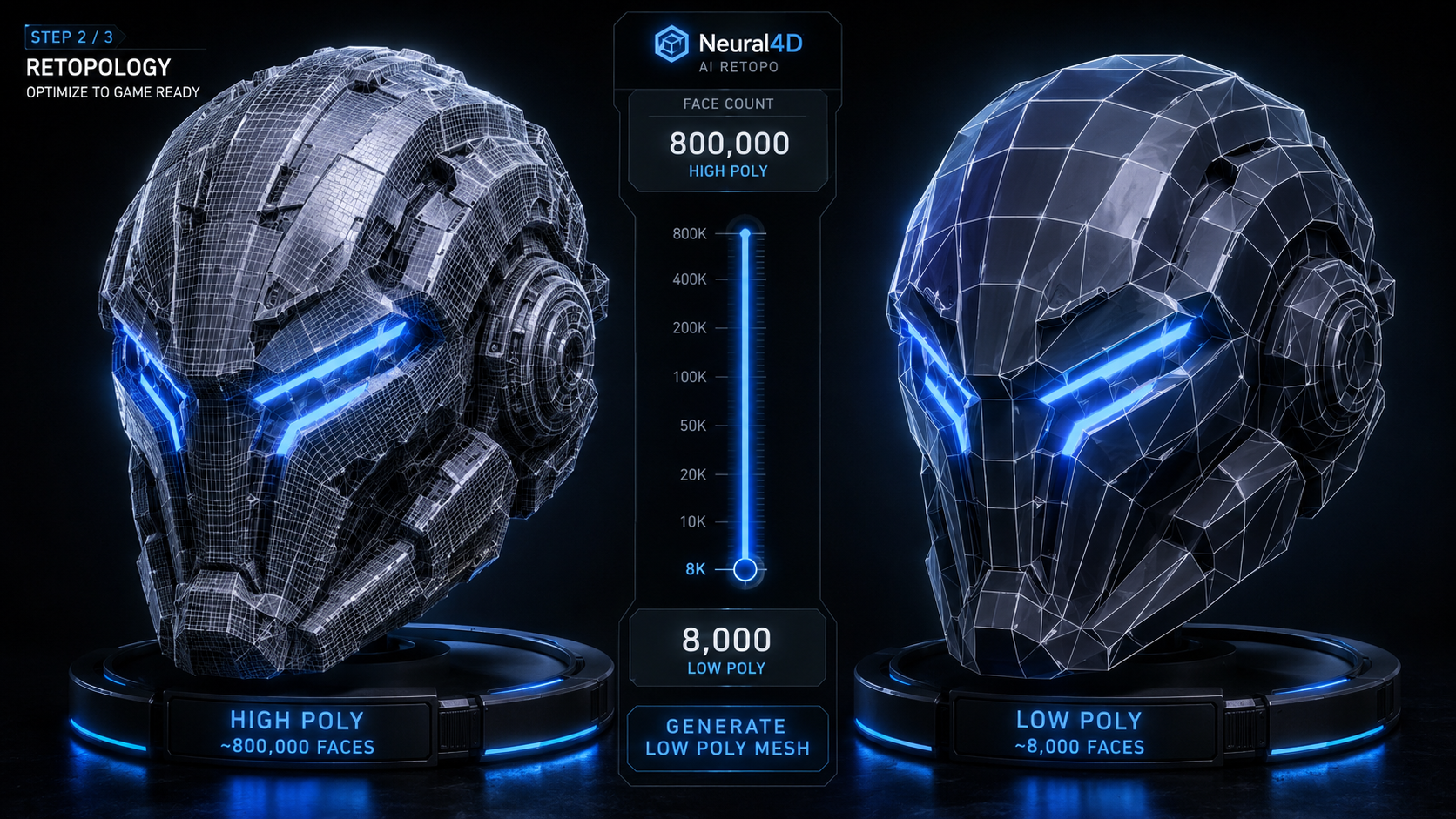
Navigate to the native AI Retopo tool within the Studio. Select your generated model and input your precise rendering budget, choosing any target face count between 500 and 150,000 polygons to execute intelligent mesh reduction.
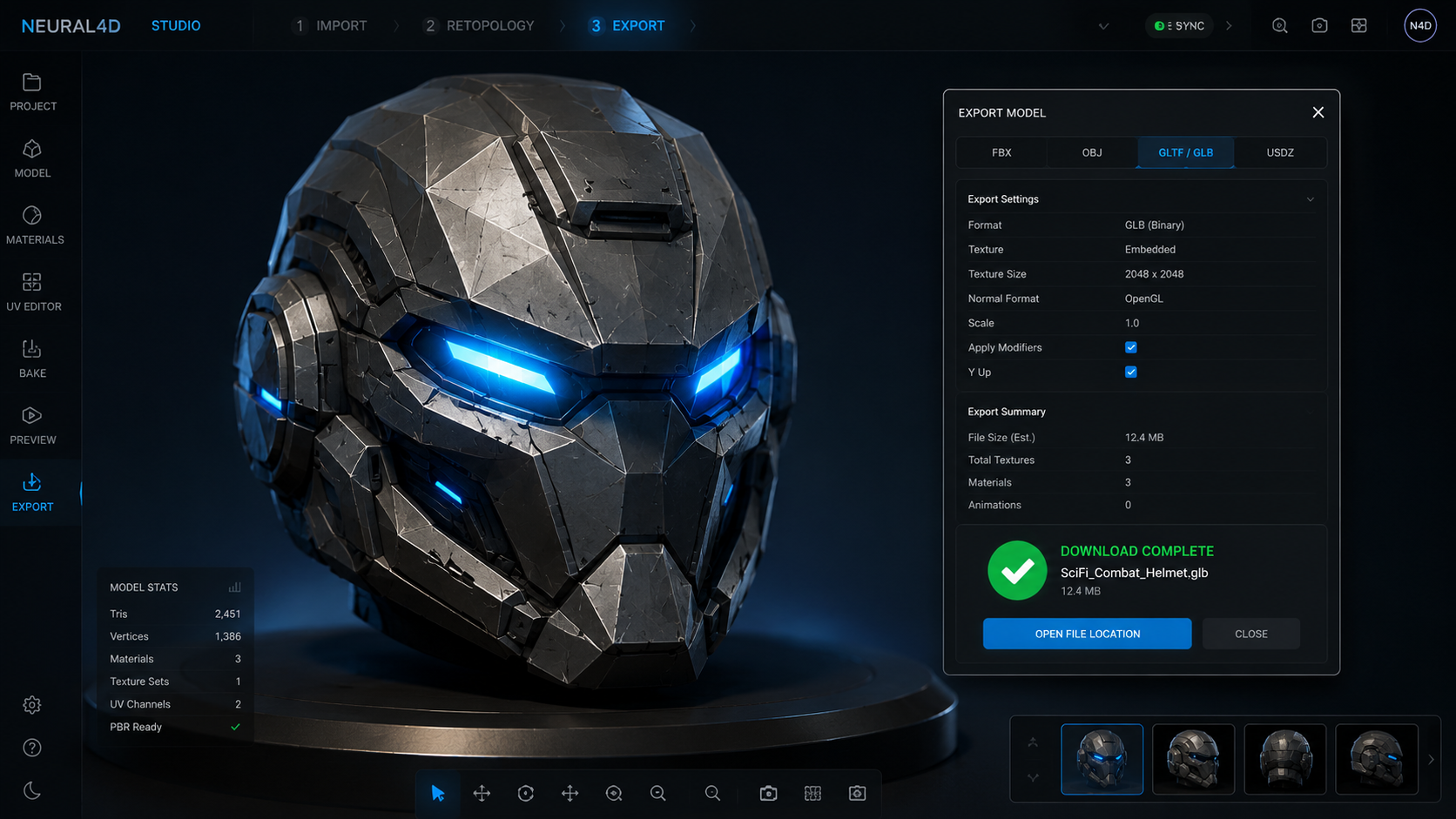
Download your decimated 3D asset in GLB or OBJ format. The AI algorithm successfully reduces the vertex count while preserving the original 4K PBR material mapping and watertight manifold topology.

It is an AI-driven pipeline that enables you to create and optimize 3D assets with minimal polygon counts. By generating a high-density base mesh first, the generator then uses an AI Retopology engine to intelligently decimate the geometry down to your target face count (e.g., 500 to 150,000 faces) while preserving the original PBR textures and silhouette.
Low poly models are essential for performance optimization. High face counts can cause extreme lag in real-time applications like mobile games or WebAR. Decimating models to a lower face count significantly reduces draw calls and memory usage, ensuring stable framerates without sacrificing too much visual quality.
Yes. After generating your initial 3D mesh via the Text to 3D or Image to 3D tool, you can import it into the Neural4D AI Retopo studio. There, you can explicitly set your target face count ranging from 500 up to 150,000 polygons before initiating the decimation process.
No. Our decimation algorithm is specifically designed to retain the UV mapping and 4K PBR textures generated during the initial phase. The detailed texture maps (such as normal and roughness maps) compensate for the reduced geometric detail, ensuring the low poly asset still looks highly realistic in game engines.
Once the AI Retopology process is complete, you can download your optimized asset in standard GLB or OBJ formats. Both formats are universally supported and ready for immediate deployment in environments like Unity, Unreal Engine 5, or direct WebGL integrations.

'%3e%3cg%3e%3cpath%20d='M14.22126,2L16.980341,2L10.922359,8.365314L18,17.000000999999997L12.44585,17.000000999999997L8.0973005,11.7527676L3.1189604,17.000000999999997L0.35988006,17.000000999999997L6.7777414,10.1918821L0,2L5.6921029,2L9.6207924,6.7933583L14.22126,2ZM13.255582,15.505536L14.785071,15.505536L4.88837,3.4391145L3.2449181,3.4391145L13.255582,15.505536Z'%20fill='%23ffffff'%20fill-opacity='1'%20style='mix-blend-mode:passthrough'/%3e%3c/g%3e%3c/g%3e%3c/svg%3e)
'%3e%3cg%3e%3cg%3e%3cpath%20d='M17.776579953674315,4.238972914697266C18.530987953674316,2.8357112146972656,17.668764953674316,1.0000038146972656,17.668764953674316,1.0000038146972656C15.728984953674317,1.0000038146972656,14.327326953674316,2.2953194146972655,14.327326953674316,2.2953194146972655C13.572919953674317,1.8635447646972656,11.093512553674316,1.8635447646972656,11.093512553674316,1.8635447646972656C11.093512553674316,1.8635447646972656,8.614197253674316,1.8635447646972656,7.859790753674316,2.2953194146972655C7.859790753674316,2.2953194146972655,6.4587898536743165,1.0000038146972656,4.518257353674317,1.0000038146972656C4.518257353674317,1.0000038146972656,3.6561312536743165,2.8350313146972654,4.410538953674316,4.238972914697266C4.410538953674316,4.238972914697266,2.6862124236743163,5.858135714697266,3.332825653674316,9.312969214697265C3.9408041536743164,12.559363814697265,6.782133553674316,13.415479814697266,8.614197253674316,13.415479814697266C8.614197253674316,13.415479814697266,7.859790753674316,14.063154814697265,7.967603653674316,15.142524814697266C7.967603653674316,15.142524814697266,6.889853453674316,15.790198814697266,5.812196053674317,15.358415814697265C4.734538553674316,14.926723814697265,4.1956536536743165,13.847263814697266,4.1956536536743165,13.847263814697266C4.1956536536743165,13.847263814697266,3.1179590536743165,12.443964814697265,2.0402743556743164,12.983694814697266C2.0402743556743164,12.983694814697266,1.7169677936743164,13.307532814697266,2.9024282136743165,13.847263814697266C2.9024282136743165,13.847263814697266,3.7645722536743165,15.142524814697266,4.087878753674316,15.898144814697266C4.411195253674316,16.653767814697268,6.135446553674316,17.301444814697266,7.860446953674316,16.869661814697267L7.860446953674316,19.352327814697265C7.860446953674316,19.352327814697265,7.860446953674316,19.568219814697265,7.4293847536743165,19.676166814697265C6.998322453674317,19.784110814697264,6.998322453674317,20.000003814697266,7.213853853674316,20.000003814697266L14.974576953674317,20.000003814697266C15.190109953674316,20.000003814697266,15.190109953674316,19.784110814697264,14.759046953674316,19.676166814697265C14.327983953674316,19.568219814697265,14.327983953674316,19.352327814697265,14.327983953674316,19.352327814697265L14.327983953674316,16.869661814697267C14.327983953674316,16.869661814697267,14.337451953674316,15.575053814697265,14.327983953674316,15.142524814697266C14.304263953674317,14.057753814697266,13.573576953674316,13.415479814697266,13.573576953674316,13.415479814697266C15.405640953674316,13.415479814697266,18.246925953674317,12.559363814697265,18.854893953674317,9.312969214697265C19.501579953674316,5.858135714697266,17.777234953674316,4.238972914697266,17.776579953674315,4.238972914697266L17.776579953674315,4.238972914697266Z'%20fill='%23ffffff'%20fill-opacity='1'%20style='mix-blend-mode:passthrough'/%3e%3c/g%3e%3c/g%3e%3c/g%3e%3c/svg%3e)


